
Inside this lesson
Over/under goals, also called totals, asks a simple question: will the match produce more or fewer goals than a set number? You do not have to pick a winner, which is why the market is popular. To understand it properly, you need to know how the lines work, how they settle and how a goals estimate becomes a probability.
The basic line: 2.5 goals
The most common line is 2.5 goals:
- Over 2.5 wins if the match has 3 goals or more.
- Under 2.5 wins if it has 0, 1 or 2 goals.
The half goal exists so there is always a result: a match cannot have 2.5 goals. Other common lines are 0.5, 1.5, 3.5 and 4.5, and they work the same way. Unless the rules say otherwise, only goals in normal time count, not extra time or penalties.
Whole-number lines
Some lines use whole numbers, such as over 2 goals. If the match ends with exactly 2 goals, the bet is a push: the stake is returned.
| Total goals | Over 2 | Under 2 |
|---|---|---|
| 0 or 1 | Loses | Wins |
| 2 | Stake returned | Stake returned |
| 3 or more | Wins | Loses |
Quarter lines (Asian totals)
Lines such as 2.25 or 2.75 split the stake in half across the two neighbouring lines.
A bet of 10 on over 2.25 is really 5 on over 2 and 5 on over 2.5. If the match has 3 goals, both halves win. With exactly 2 goals, the over-2 half is returned and the over-2.5 half loses, so you get back half your stake. With fewer goals, both halves lose.
From expected goals to a probability
To judge a totals price, you need an estimate of how many goals a match is likely to produce. A common simple model treats goals as random events that happen at an average rate, using the Poisson distribution.
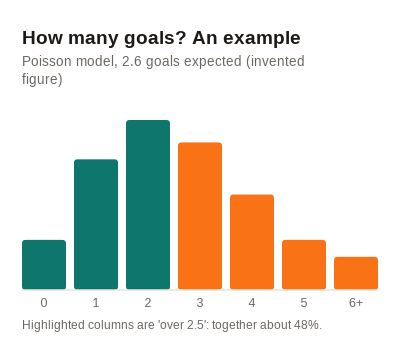
Suppose a match is expected to produce 2.6 goals in total, an invented figure for illustration. The Poisson model gives a 51.8% chance of 2 goals or fewer and 48.2% of 3 or more. At an expected 2.2 goals, the chance of over 2.5 falls to about 37.7%; at 3.0 goals, it rises to about 57.7%.
2.2 | expected goals → 37.7% over 2.5 2.6 | expected goals → 48.2% over 2.5 3.0 | expected goals → 57.7% over 2.5
Two lessons follow. First, small changes in the expected number of goals move the probability a lot. Second, the line of 2.5 sits close to the average of many leagues, so prices are often near even money once the margin is included.
The Poisson model is a simplification. Real matches are affected by the score: a team that falls behind attacks more, and red cards change everything. More advanced models adjust for this, but the simple one shows how the market thinks.
What affects the number of goals
- Attack and defence quality of both teams, ideally measured with expected goals rather than recent scores.
- Playing style: pressing, possession and counter-attacking teams produce different matches.
- Motivation: cup ties that need a result often open up late on.
- Team news: missing strikers or defenders.
- Conditions: weather and pitch quality.
Common mistakes
- Remembering high-scoring matches. Exciting 4–3 games stick in the memory; dull 0–0s do not.
- Using too few matches. A team's last three games say very little about its true goal rate.
- Ignoring the margin. As in every market, the prices include a margin. Turn them into percentages with the odds converter.
Understanding how totals work is not the same as having an edge. Most bettors lose over time because of the margin. Set limits before you bet: see Setting Limits Before You Start.
- Over/under 2.5 wins on 3+ goals for over and 0–2 for under; whole-number lines can push.
- Quarter lines split the stake across two neighbouring lines.
- A Poisson model turns an expected number of goals into the probability of each total.
Test a score exactly on the boundary
Use a hypothetical score equal to the whole-number line, then compare settlement at the neighbouring half and quarter lines. This exposes refunds and split stakes that the headline odds do not explain. A goals estimate should be translated through the actual line's settlement rules.
18+ only. Betting involves risk. See our Responsible Gambling page.

Learn betting the right way.