
Inside this lesson
A bankroll is the amount of money you set aside for betting, kept separate from everything else. It sounds like a detail, but it is the most important decision in this whole school, because it decides how much you can lose. This lesson explains how to set one, how to size your stakes and why long losing runs are normal.
Start with what you can afford to lose
The right size of a bankroll is not a percentage of your savings or a target you want to reach. It is the amount you could lose completely without it affecting your life: rent, bills, food, debts and the people who depend on you.
Never use money for essentials, borrowed money or money you are hoping to win back. If betting is the only way you can see to fix a money problem, that is a sign to stop, not to bet more. Free, confidential help is listed on our Responsible Gambling page.
Think of the bankroll as the price of entertainment for a set period, such as a month. When it is gone, betting stops until the next period.
Keep it separate
A bankroll only works if it is separate:
- Use a separate account or a fixed amount loaded onto your betting account.
- Do not top it up in the middle of a period after losses.
- Do not count winnings as "free money": they are part of the bankroll.
Stake size: why flat staking
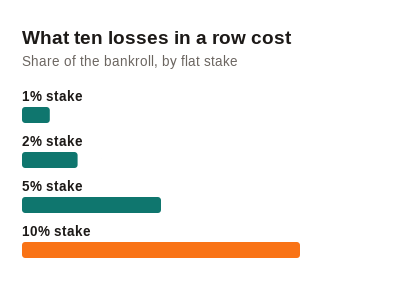
Once the bankroll is set, decide how much to bet each time. The simplest and safest method is flat staking: the same small stake on every bet, usually 1% to 2% of the starting bankroll.
Invented figures. A bankroll of 200 with a flat stake of 2% means 4 per bet. Even a run of 10 losing bets in a row costs 40, a fifth of the bankroll. With a stake of 20% (40 per bet), the same run would wipe it out after five bets.
1–2% | of the bankroll per bet with flat staking 10 | losing bets in a row cost 20% at a 2% stake 5 | losing bets in a row empty the bankroll at 20%
Losing runs are longer than you think
Even bets with a decent chance of winning lose in streaks. If each bet has a 50% chance, the chance of losing at least five in a row somewhere in 100 bets is about 81%, and of losing seven in a row about 32%. Streaks are normal; they are not a sign that a win is "due".
That is why the stake has to be small: a bankroll must survive the bad runs that will certainly come.
The stake size decides how fast you can lose. A small, fixed stake does not make betting profitable, but it makes losses slower and easier to control.
Strategies to avoid
- Chasing losses: raising stakes to win back what you lost. It turns a bad day into a disaster.
- The martingale: doubling the stake after every loss. A short losing run makes the stakes huge, and table or account limits stop you long before the "guaranteed" win.
- Raising stakes after wins because you feel "hot". Results do not have a memory.
Review and stop points
Set the rules before you start:
- Bankroll per period, for example per month.
- Stake size, fixed.
- Stop point: when the bankroll is gone, you stop until the next period.
- Time limit: how long you will spend betting.
Recording every bet makes it easier to stick to these rules. See How to Keep a Betting Record and Setting Limits Before You Start.
- A bankroll is money you can afford to lose entirely, kept separate from everything else.
- Flat stakes of 1–2% help a bankroll survive normal losing runs.
- Never chase losses or top up a bankroll mid-period.
Separate entertainment money from obligations
Start with whether the money is genuinely affordable to lose, not with a target income. Keep essential expenses outside the calculation and set a clear stopping rule. A staking system can describe exposure, but it cannot make an unfavourable game profitable or prevent every losing streak.
18+ only. Betting involves risk. See our Responsible Gambling page.

Learn betting the right way.