
Inside this lesson
An accumulator, or acca, combines several selections into one bet. Every selection, called a leg, must win for the bet to pay. The appeal is obvious: small stakes, big potential returns. The catch is just as clear once you do the maths, and this lesson does exactly that.
How the odds are combined
The odds of an accumulator are the odds of its legs multiplied together.
Four legs, each at decimal odds of 1.80: 1.80 × 1.80 × 1.80 × 1.80 = 10.50. A stake of 10 would return 105 if all four win.
That multiplication is what makes the returns look attractive. The same multiplication applies to the probabilities, which is where the trouble starts.
The chance of winning falls fast
If each leg has a 53% chance of winning (odds of 1.80 imply 55.6%, and the margin takes a little off), the chance that all four win is:
0.53 × 0.53 × 0.53 × 0.53 = 7.9%
In other words, this "four good-looking bets" accumulator loses about 92 times out of 100.
| Legs at 53% each | Chance all win |
|---|---|
| 2 | 28.1% |
| 4 | 7.9% |
| 6 | 2.2% |
| 8 | 0.6% |
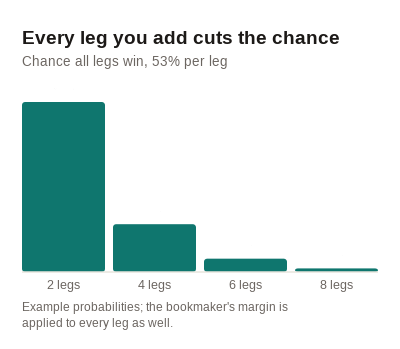
People tend to judge an accumulator by how confident they feel about each leg. But "pretty likely" four times in a row is not likely at all.
The margin compounds
Every price includes the bookmaker's margin. In an accumulator, the margins multiply too.
Suppose each leg returns, on average, 95.2% of the stake over the long run, which is what a 5% margin means. With several legs:
95.2% | average return of a single bet with a 5% margin 82.3% | average return of a 4-leg accumulator 67.7% | average return of an 8-leg accumulator
So a single bet with a 5% margin costs you, on average, about 4.8% of your stake. An eight-leg accumulator built from the same kind of prices costs about 32%. The more legs, the larger the bookmaker's built-in edge.
An accumulator does not just multiply the odds. It multiplies the bookmaker's advantage. That is why accas are among the most heavily promoted bets.
Why they feel close
Accumulators often lose by "just one leg". That feels like bad luck, but it is what the maths predicts: when you need many things to go right, it is very common for most of them to succeed and one to fail. Near misses are part of the design, not a sign you were almost right.
Variants you may see
- Doubles, trebles and system bets (for example a "Yankee") combine the same selections into many smaller accumulators. They lose less when one leg fails, but each smaller bet still carries a compounded margin, and the total stake is larger.
- Acca insurance returns the stake, often as a free bet, if one leg fails. It changes the shape of the losses, not the underlying maths.
- Bet builders combine several events from the same match. Because those events are related, pricing them is complex and margins are often higher.
If you still want to place one
- Keep it small: a stake you treat as entertainment, inside your bankroll.
- Use fewer legs. Each extra leg costs more than it seems.
- Convert the combined odds into a probability with the odds converter and ask whether that probability matches your expectations.
Large advertised returns on accumulators are rare by design. Never stake money you need, and never try to win back losses with bigger accumulators.
- Accumulator odds and probabilities are both multiplied, so the chance of winning drops quickly.
- The bookmaker's margin compounds with every leg added.
- Losing by one leg is the expected outcome, not near success.
Write down the dependence assumption
Multiplying individual chances is appropriate only when the independence assumption is justified. Related selections need a joint probability, not a shortcut based on their separate prices. Compare the full accumulator with its components on paper; a larger advertised return does not make the combined outcome more likely.
18+ only. Betting involves risk. See our Responsible Gambling page.

Learn betting the right way.